

1,747 words in this newsletter - about 7 minutes and 21 seconds to read.
Meet our Newest Team Member: Bridget Gilmore

January 5 marked more than just the Cityfi team’s first workday after a well-earned holiday break—it was also day one for our newest Cityfier! Please help us welcome Bridget Gilmore, our newest Senior Associate! Bridget brings a rare and wonderful combo to Cityfi: a love of science paired with a passion for clear, compelling communication. She’ll be working across Cityfi projects, and we can’t wait to see her work her magic.
With nearly a decade of experience, Bridget has partnered with public-private coalitions, the federal government, state and local agencies, utilities, and advocacy organizations to advance transportation electrification, automation, and innovation. Most recently, Bridget was at the Joint Office of Energy and Transportation where she worked on furthering the mission of the office by supporting stakeholders to efficiently and effectively deploy federal funding. A standout moment? Helping plan an electric vehicle (EV) road trip for the Secretary of Energy which spanned 800 miles, 12+ hours of driving, four states in four days, with three different American-made EVs traveling together using public charging infrastructure. Safe to say, she will be our go-to for road trip advice.
A few fun facts about Bridget:
She’s lived in a variety of places - from the extremely rural town of Yungaburra, Queensland, Australia (population: 1,272) to the City of Chicago. She now calls Roanoke, VA home.
When she’s not working, she’s growing vegetables, mountain biking, rock climbing, or hiking with her two hound dogs.
Her signature dish is chili (strong opinions not only allowed, but encouraged).
Now that you know Bridget, keep reading our latest newsletter (edited by her!) to get a glimpse of what she’s passionate about in the Cityfi world.
Innovations Making Transportation More Affordable
Guest Editor: Bridget Gilmore
Across the five new mayors who took office this month in New York City, New Orleans, Hoboken, Jersey City, and Detroit, and two new Governors in Virginia and New Jersey, the pressing item on every agenda is how to create affordable solutions for Americans. Transportation is the second largest expense for Americans after housing, averaging more than $13,000 annually. Data from the Bureau of Transportation Statistics found that lower-income households spend 30% of their after-tax income on transportation alone.
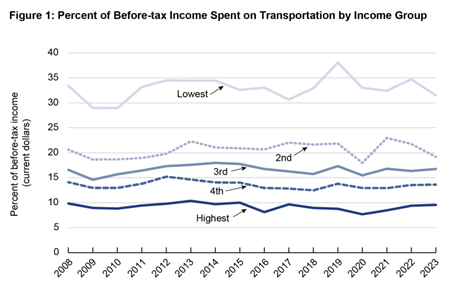
Figure 1. Calculations by U.S. Department of Transportation, Bureau of Transportation Statistics, from U.S. Department of Labor, Bureau of Labor Statistics, Consumer Expenditure Survey calendar year means, available at www.bls.gov/cex as of November 2024.
This newsletter will delve into how new technologies can move the needle for transportation affordability in 2026 and beyond. These innovation trends will be discussed across three themes: electrification, automation, and right-sizing modes of transportation. To introduce our acronyms, we are talking about EVs, autonomous vehicles (AVs), and light utility vehicles (LUVs).
EVs Are a Solution to Counteract Utility Rate Increases

With rising electricity prices, there are certainly challenges to already fraught American EV adoption. However, EVs present an untapped solution to counteract rising electricity prices, which are unfortunately projected to continue to climb higher in 2026.
The research: The LBNL and Brattle Group study, published in October 2025, did a great job of examining the underlying cost drivers for rising electricity prices. They found that up until 2024, electricity costs were tracking inflation and increasing at the same pace as other household expenditures, while remaining less volatile than natural gas or gasoline.
The trend shifted in 2025. From January to July, retail electricity prices outpaced inflation, rising 4.4% compared to a 1.9% inflation-adjusted increase over the same period in 2024. Overall, these recent price hikes seem to be driven by increased spending on outdated transmission and distribution infrastructure to serve new loads (like data centers) while generation costs have declined.
Like transportation costs, energy expenditures can be a major expense for households. The study found that 24% of households were unable to pay their energy bill in full in 2024, up 4% from 2021 levels. This issue worsens by rapidly rising residential electricity rates, which are predicted to continue to increase in 2026.
The challenges: While the LBNL study found that EV infrastructure did not have any significant impacts on rising prices (in California, there was less than 1% of direct impact on retail sales), this rise in electricity costs does present a challenge to EV economics. EVs had generally been touted to have a lower total cost of ownership than traditional internal combustion engine vehicles due the lower cost of electricity and subject to less price volatility. When previously an avenue for consumers to lower their transportation expenditures, these rapidly changing conditions provide less certainty that the higher sticker price will be counteracted by lower operations and maintenance costs. This higher operating cost is then compounded by the loss of federal EV tax credits to lower the upfront purchase price, making EVs much less affordable than they were for consumers a year ago.
The innovation opportunities: There is so much untapped potential to lower electricity prices through transportation electrification. Smarter utility policies could incentivize EV charging when there is excess capacity on the grid overnight. Nationwide adoption of vehicle-to-grid technologies can maximize the potential of EVs to serve as additional energy resources when the grid is constrained. Electric transportation offers a way to better utilize our existing grid infrastructure and drive rates down for everyone by spreading fixed costs over a larger customer base. Despite softening U.S. original equipment manufacturer (OEM) electrification ambitions, EVs are here to stay and adoption is growing rapidly across the globe. It is imperative that stakeholders across the state and local level consider how we can work smarter to counteract rising rates. EVs can serve as a critical piece to get full use of our already-paid-for grid infrastructure and lower our energy bills.
The Promise of Autonomy: Saving Lives, Saving Money

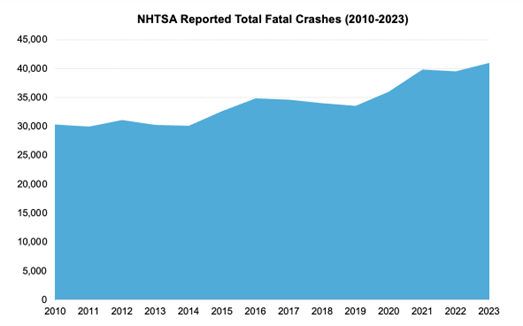
Each year, roughly 34,000 people are killed in traffic crashes on U.S. roads. In 2023 alone, that number climbed to more than 40,000 fatalities. These terrible accidents can be attributable to a number of human factors including speeding, distraction, impairment, or age. While new and improved safety features are continually rolled out with new vehicle models, mortality and injury rates have remained, unfortunately, stubbornly consistent. In 2010, there were 25% fewer people involved in fatal car crashes than 2023. This troubling trend shows that technology improvements cannot fix the fact that there is a person–an increasingly distracted person–behind the wheel.
Autonomous vehicles (AVs) have been widely discussed as a critical innovation to improve transportation safety and have the potential to reduce the economic costs of our transportation system. The cost savings potential of AVs can be viewed from a macroeconomic standpoint while also considering how individuals could save on their per-trip costs. Conducting analysis from an economy-wide viewpoint, the U.S. Chamber of Commerce found that if 25% of vehicles on the road were Standard AVs, defined as “programmed to follow traffic laws and operate like an unimpaired human driver with sensors to determine distances and speeds of other vehicles,” there would be an estimated 1,145,000 fewer crashes, 9,000 fewer fatalities, and $75 billion saved in avoided costs annually.
From an individual personal accounting standpoint, shared AV rides are expected to be less expensive when compared with personal vehicle use. An analysis from the Union of Concerned Scientists estimated that a shared AV ride will cost a person $0.21 per mile compared with $0.59 per mile for privately owned automobiles. While reducing costs, AVs can also expand transportation access, particularly for older people and people with disabilities who are unable to rely on traditional forms of private or public transportation.
By reducing crashes, lowering per-trip costs, and expanding mobility, autonomous vehicles offer a rare opportunity to improve safety and affordability at the same time. As cities and states grapple with rising transportation costs, AVs represent a powerful tool to save lives while easing the financial burden on households.
The Future is Small: How Local Use Vehicles Can Close the Mobility Gap
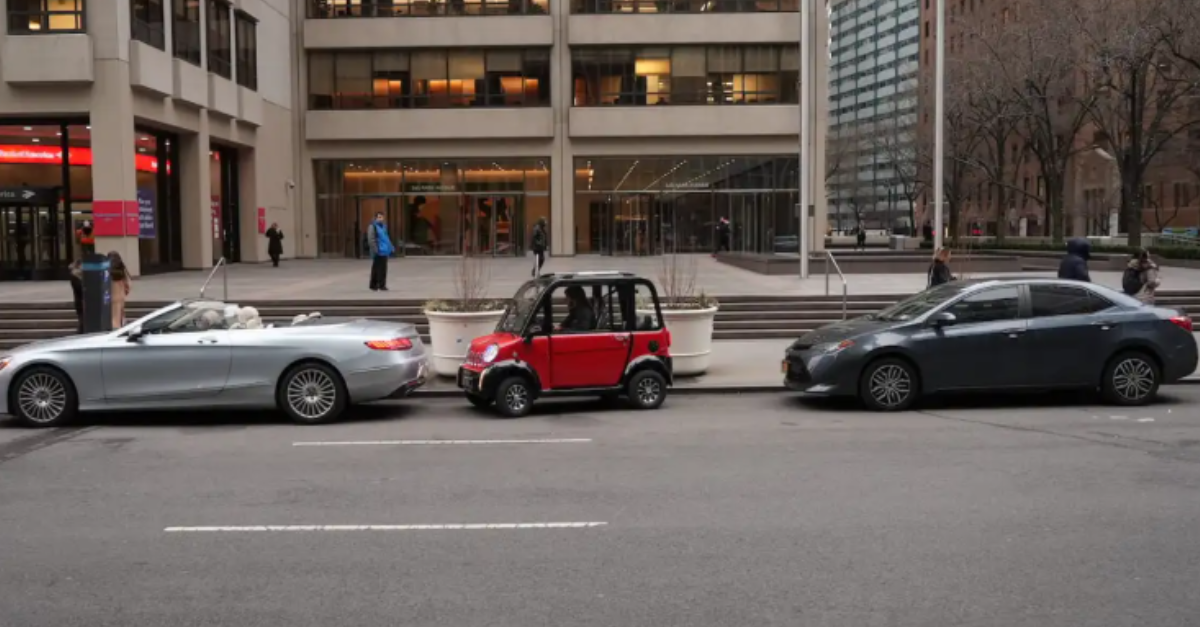
For decades, the American transportation system has been designed around accommodating two extremes: the high-speed highway and the sidewalk. But as the cost of living rises and our streets become more congested, a “missing middle” is emerging. Enter Local Use Vehicles (LUVs) - a right-sized solution to suit our actual needs.
LUVs are a category of small, lightweight, and typically electric vehicles designed for local trips. They exist in the space between a bicycle and a full-sized passenger vehicle. Often classified as Neighborhood Electric Vehicles (NEVs) or Low Speed Vehicles (LSVs), they can provide the weather protection and storage capacity that micromobility and bicycles lack, without the massive footprint of a standard car.
Over 52% of all daily trips in the U.S. are under three miles, yet we regularly use 4,000-lb vehicles costing an average of $48,000 to complete them. Because LUVs have a significantly lower purchase price and minimal maintenance costs, they can provide families with the flexibility to limit their household to one full-sized vehicle, while maintaining a LUV for shorter, daily trips. Moving these short trips to a LUV can slash fuel, insurance and financing costs.
While the concept is gaining momentum in the U.S., LUVs are already a staple of global mobility:
Europe: Quadricycles are common in dense historic city centers.
Japan: Kei cars have been a pillar of the Japanese economy for decades, specifically designed to fit into tight urban spaces and narrow residential streets.
Southeast Asia: Autorickshaws and tuk-tuks are commonly used for short, low-cost trips, and increasingly for last mile delivery.
In the U.S., LUVs are primarily used as a “neighborhood-first” solution - used for grocery store trips, school drop off, and visits to the local pharmacy. Increasingly, last mile logistics companies are adopting LUVs as a more cost efficient alternative to delivery fleets, especially in congested urban cores. In the coming years, we expect residents in densely populated urban cores and planned towns will lead adoption, alongside utility fleets and last-mile delivery.
Cityfi and SUMC have partnered to launch a coalition driving the momentum toward LUV adoption in the U.S. - the National LUV Working Group. This group, composed of state and local DOTs alongside innovative industry representatives, is working to bridge the mobility gap for the 36% of Americans who currently cannot rely on a personal vehicle for their daily needs.
The Working Group will focus on streamlining the regulatory patchwork that has historically blocked innovation for LUVs. By harmonizing state and local laws, this coalition is crafting a national blueprint to ensure that the potential for LUVs is realized. Want to learn more about the Working Group, let me know!
The Cityfi Cluster #9 Solution
By Ryan Parzick
As noted in our last newsletter, December marked the conclusion of the Cityfi Cluster, our own version of the New York Times Connections game. Thank you all for playing!
Last month’s solutions are:
Finality: Culmination, Denouement, Sunset, Farewell
Looking Back: Retrospective, Recollection, Memories, Review
Looking Forward: Aspirations, Forecast, Roadmap, Resolution
December Celebrations: Winter Solstice, Festivus, Boxing Day, New Year’s Eve
Where in the World is Cityfi?
Check out where Cityfi will be in the upcoming weeks. We may be speaking at conferences, leading workshops, hosting events, and/or actively engaging in collaborative learning within the community. We would love to see you.
Cityfi Retreat! - Miami, FL - February 9th & 10th
Our team is convening in warm and sunny Miami to strategize, improve, and push CItyfi forward in our 10th year of existence. If any of our friends are around, let us know!
Knight Media Forum 2026 - Miami, FL - February 10th - 13th
Join Senior Principal Camron Bridgford in Miami as she attends the annual gathering of practitioners on the frontlines of local journalism, civic engagement, research, academia and the arts. The focus is on advancing local solutions with national relevance and national solutions with local applications. The forum will spotlight local leaders driving change in their communities and host forward-looking, solutions-oriented conversations on some of today’s most urgent challenges and opportunities. Connect with Camron and let her know you want to meet up!
Chicago City Builders Book Club - Chicago, IL - March 4th
If you live in Chicago and consider yourself an urbanist, designer, policy pro, and just someone who likes to read and talk about Chicago, check out the Cityfi sponsored Chicago City Builders Book Club! Join them for Part II of the discussion of William Cronon’s Nature’s Metropolis: Chicago and the Great West. The book was split into 3 parts, so even if you missed Part I, feel free to come and join for Parts II and III as each session will stand on its own. Together they will provide a deeper understanding of how Chicago became the metropolis that shaped a region. Principal Marla Westervelt normally co-hosts this book club, bringing together professional city builders to discuss Chicago-centric books that explore local urban and political issues. Check out their LinkedIn page for updates.
What We’re Reading
Articles handpicked by the Cityfi team we have found interesting:
Energy: Gov. Pritzker Signs Historic Clean and Reliable Grid Affordability Act
CleanTech: Voltpost and EVSE bet on next-gen lamppost charging for US cities
Civic Innovation: Illinois’ Low-Cost Library Program Takes on the Justice Gap
All Things Cityfi
Your guide to our services, portfolio of client engagements, team, and…well, all things Cityfi.